
As the year wraps up, credentialing and certification teams step into one of the most important—and often most hectic—seasons of the year. Requirements reset, new applications open, exam windows shift, and recertification timelines begin again. With so many moving pieces, year-end can either become a bottleneck or an opportunity to strengthen your entire operation.
No matter what system you use for managing your certification program, the tasks below will help you start 2026 with accuracy, clarity, and confidence. And if you’re using ROC-P, many of these actions become automated steps that work quietly in the background. That means freeing your team to focus on supporting users and advancing your profession.
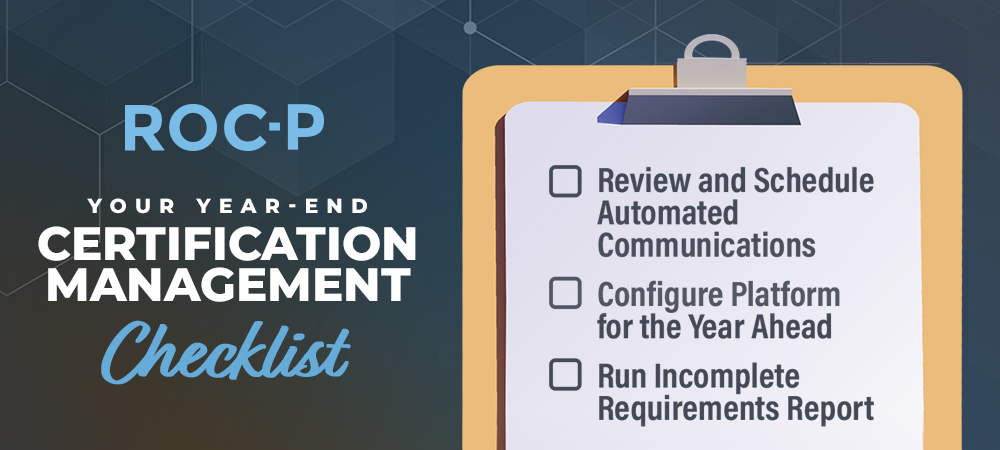
1. Review and Schedule Your Automated Communications
Clear communication sets the tone for a smooth transition into the new year. Now is the time to queue up the messages your users rely on most.
Recommended year-end communications include:
- Recurring incomplete requirement reminders. Help users stay on track by continuing these messages through December 31.
- Recurring renewal deadline reminders. If your renewal cycle closes at year-end, schedule or extend automated prompts so no one misses their window.
- A scheduled “Happy New Year” announcement. A simple automated message sent on January 1 can confirm new cycles, reinforce next steps, and create a polished experience.
These touchpoints not only reduce confusion—they also eliminate manual email outreach during your busiest season.
2. Configure Your Platform for the Year Ahead
Year-end is the moment when configuration matters most. The settings you update now determine what your candidates see, how your workflows behave, and how smoothly the new cycle launches.
A well-configured certification management platform ensures that when January 1 arrives, everything in your program—from applications to CE requirements—is already aligned with your new standards.
As you prepare for the new year, confirm that your credentialing platform reflects your upcoming cycle, including:
- 2026 renewals. Update renewal windows, requirement structures, and fees so your platform mirrors your policy updates for the year.
- 2026 applications. Configure or schedule the opening of next year’s initial and recertification applications, ensuring they route users through the correct eligibility and workflow logic.
- 2026 exams. Add or adjust exam offerings, dates, registrations, and fees so users can see accurate, up-to-date information the moment they log in.
When these components are configured in advance, your platform becomes a reliable extension of your policies, reducing manual intervention, eliminating candidate confusion, and giving your team a seamless start to 2026.
Not sure if your platform is configurable or custom? Learn the difference here.
3. Run Your Incomplete Requirements Report
Before new cycles generate on January 1, it’s essential to identify who is at risk of not rolling over correctly. Remember that if a certified user is due for recertification on Dec. 31, but has at least one incomplete or unstarted requirement, they will not receive their new cycle or recertification date on January 1.
To prevent that from happening:
- Run your Incomplete Requirements report. Look for candidates with unfinished CE, assessments, payments, or other requirements.
- Notify affected individuals (automatically, if your system allows). Early awareness drives action and reduces January support tickets.
- Confirm requirement statuses for any edge cases. This avoids manual corrections later and ensures fairness for all candidates.
Doing this single task can save your team countless hours of clean-up in January.
4. Determine Whether Users Need an Extension
For users who miss a hard deadline, year-end is when you decide how to manage extensions within your policies.
In ROC-P, this is as simple as enabling them to complete remaining items after the deadline. In other systems, this may require manual overrides or date adjustments.
The goal is to create a consistent, policy-aligned pathway that:
- Maintains fairness
- Reduces administrative work
- Eliminates case-by-case exceptions in January
- Helps candidates maintain their credential without starting from scratch
5. Clean Up User and Program Data
Accurate data entering the new year means more accurate reporting, fairer decision-making, and fewer support tickets. Consider these quick wins:
- Merge or correct duplicate records
- Review CE uploads awaiting approval
- Close out applications that have been inactive
- Archive or complete test records from staff or committee reviews
- Ensure exam results are fully imported before the new cycle begins
A clean database empowers your team with confidence and helps your users see a true reflection of their progress.
Start 2026 with Confidence
Every credentialing team deserves a new year that begins smoothly—not with a rush of corrections, emails, and manual updates. By taking these steps now, you set up your entire program, your staff, and your users for success.
And if you’re using ROC-P, you’re not doing it alone. Our platform is built to support the full lifecycle of your certification workflows, automate key transitions, and reduce the burden on your team during the busiest times of the year.
If you’d like help configuring any of your year-end processes, or you’re curious how ROC-P can streamline tasks like these, we’re here to guide you. Reach out and let’s talk about achieving operational excellence in the new year!